Transcript
As spoken by Mariana Messias Campos
This transcript is drawn from an audio recording. It has been lightly edited for clarity and readability while preserving the participant’s original voice and meaning.
Growing up in Neutral Bay was a mix of emotions. I think that North Sydney, or the North Shore, wasn't really ready to see a family like mine, being Latinx and being in this space. Just kind of growing up here wasn't the easiest.
There were amazing moments, but I have a lot of memories of growth here from everything that I went through in terms of discrimination and racism, and just having to not only come to terms with who I am as a queer person, but also having to understand that you are a person of colour, and I think that's where I learnt that.
I moved here when I was a teenager, and so in that time I kind of understood what it means to be a person of colour in an area that's predominantly white people. And I think also uncovering my queerness at the same time and understanding how I want to present myself as a more masculine person too.
I didn't really understand my queerness at that point. So growing up here, there wasn't much queer representation as well. Being a lesbian here, I was kind of lost. I didn't feel like there was a space to see myself or much representation.
So when I saw the Be Seen project, I felt like this was a good way to change that and make sure that if there is another queer person like me here, they can also see that representation as well. So I feel like when it comes to the memories of the North Shore, there weren't many. If I'm going to be truthful, I feel like this is the first step to being represented in that way.
I always knew I was queer, but I just didn't know I was a lesbian. I would say I was bisexual. It was just really confusing for me at that point. I think when I was about 21 or 22 was when I said, "Okay, I definitely think I'm bisexual." And then at 23 it was like, "Oh, I'm a lesbian, 100%." I just felt like I was 22 and I was like, "You know, I have to leave." I think for me to understand who I truly am, I need to move out and live that truth. So I just moved out randomly, out of nowhere. No plans, no savings, nothing. I just left.
And then from there, that's when I started understanding more of my queerness. I had the chance to do that. I feel like in my teen years, when I was trying to discover those parts of myself, it was really hard dealing with a parent who was going to pass away and who was sick at the time. You can't really focus on who you are during those teenage years that are the foundations of who you are. I didn't really get that.
So I think when I left, I was like, "Oh, do I like wearing these clothes? Do I want to wear this? Do I like wearing all this makeup all the time? Do I like wearing a skirt?" I was really questioning my identity at that point.
And then from there, I left, and that's when I kind of was like, boom, and it just came out, like full masc lesbian. I don't really see that as a change. I feel like I've always been this person. I feel like there's an energy to me that's always stayed the same.
I feel like being from an immigrant household, being queer is still something that is taboo and it's not necessarily accepted. So when you're already Latinx in the North Shore trying to find your way through how to be accepted and how to defend yourself, I think those intersections of my identity were really hard to manage.
So being in my mum's home represents a lot in terms of my identity and my sense of self. I think that when it comes to my queerness, it represents the intersection of my identity, and it also represents resistance. There's a lot of Black and brown artefacts here that come from a lot of Indigenous Brazilians and Northeast artists from the northern region where my mum's from.
I think that when you're a queer person of colour, being Latinx and being proud of who you are intersects with your queerness. That's why I wanted to take a photo here, because there were a lot of places where I didn't feel that safe being who I was.
And here I'm proud to be queer, and I'm proud to be a lesbian, and I feel like my mum's proud of what she's become and what she's done. So I feel like those two together are what I'm most proud of in this area: being that person, that one per cent.
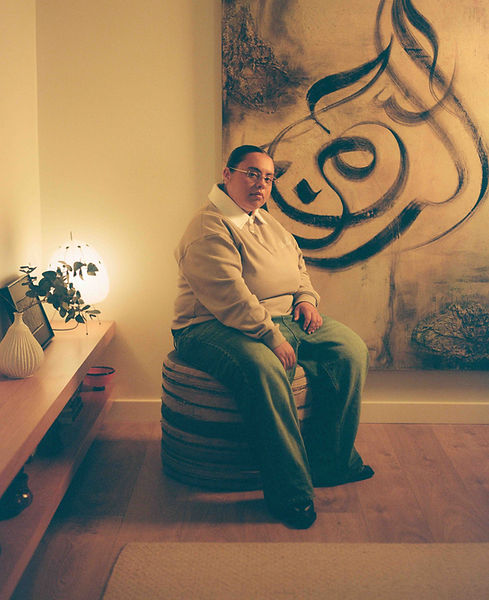
Portrait of Mariana taken at her mother's home in Mosman